

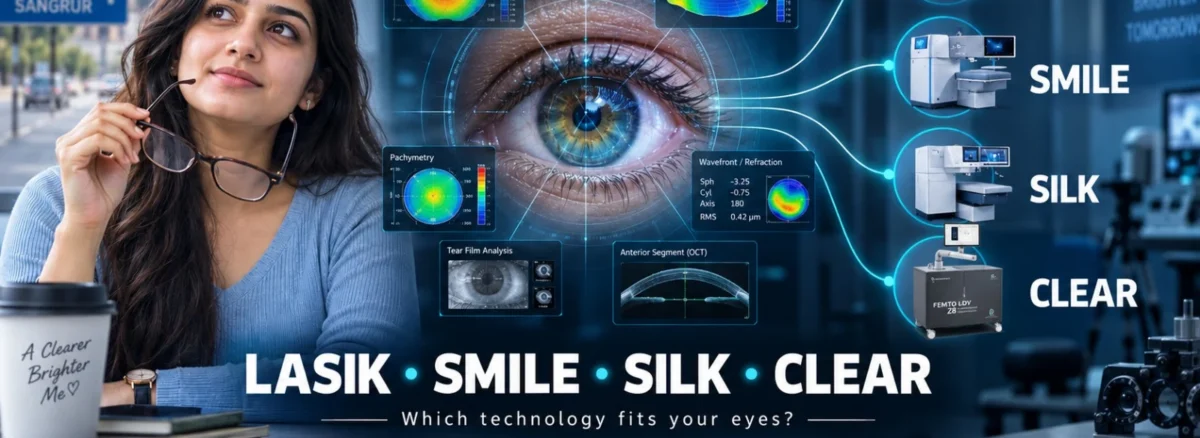
Simran had worn spectacles since she was eleven.Growing up in Sangrur, that never felt like a problem — until her twenties, when it started showing up in small, specific ways. Fogged lenses walking out of an air-conditioned bus in June. A badminton match at the community hall she sat out because her glasses kept sliding.Contact lenses that felt fine for a few hours and then didn’t.None of it was dramatic. It just added up.
What finally moved her from curiosity to a real decision wasn’t a single bad day. It was a wedding in Patiala, watching cousins who’d had LASIK years earlier read a menu in dim light without reaching for anything. She had heard the word LASIK for years the way most people in Punjab have — as a catch-all term for laser eye surgery. What she hadn’t realised was how many distinct procedures now sit under that umbrella, or how different the right answer could look for two people with an almost identical eye prescription.
That is really what this article is about. Not which laser is newest, or which name sounds the most advanced — but how a refractive surgeon actually decides what belongs on a particular pair of eyes.
Laser Vision Correction Has Changed

For a long time, “LASIK” was shorthand for the whole category, the way “Xerox” became shorthand for photocopying. That shorthand has stopped being accurate. Today’s refractive landscape includes surface procedures, flap-based LASIK in several customised forms, and a newer lenticule-based family that doesn’t use a flap at all.
Broadly, every laser procedure falls into one of three surgical concepts: surface ablation, where the laser reshapes the cornea’s outer surface directly; flap-based correction, where a thin corneal flap is lifted before the laser reshapes the tissue beneath; and lenticule extraction, where a laser shapes a small piece of tissue inside the cornea, removed through a very small incision, without a traditional flap at all.
LASIK, SMILE, SILK and CLEAR — What Actually Differs?
Surface Ablation: PRK and TransPRK

PRK (Photorefractive Keratectomy) and its more automated variant, TransPRK, reshape the cornea’s surface directly — no flap involved. Because the surface epithelium needs to regenerate afterward, visual recovery is more gradual than with flap-based methods, typically over several days rather than one. Surface ablation is often the more suitable option for thinner corneas, and remains a genuinely appropriate choice for selected patients rather than a fallback.
LASIK and Flap-Based Correction
Conventional LASIK and Femto-LASIK both involve lifting a thin, hinged corneal flap before reshaping the tissue underneath with an excimer laser. In Femto-LASIK, a femtosecond laser creates that flap rather than a mechanical blade — hence the description “bladeless” at the flap-creation step. The flap is then repositioned without stitches. The main appeal is speed of initial visual recovery, often within a day.
SMILE and SMILE Pro
SMILE (Small Incision Lenticule Extraction) removes the flap entirely. A femtosecond laser shapes a lens-like piece of tissue — a lenticule — within the intact cornea, removed through an incision only a few millimetres wide. SMILE Pro is a faster, refined version of the same underlying technique, with a shorter laser treatment time. Because there’s no flap, many patients report a smoother experience with less disturbance to the corneal surface and nerve layer — a genuine technology characteristic, though not a guarantee, since outcomes still depend on the individual eye.
SILK and ATOS
SILK belongs to the same lenticule-extraction family as SMILE — a femtosecond-laser approach that shapes and removes a small lenticule of tissue through a minimal incision, without a conventional flap. ATOS-based platforms follow a related lenticule-extraction principle. As with any platform in this category, characteristics such as laser spot pattern, energy delivery, or incision size describe how the laser is engineered to behave — they are technology characteristics, not guarantees of a specific outcome for a specific eye.
Ziemer CLEAR
CLEAR (Cornea Lenticule Extraction for Advanced Refractive Correction) is a newer entrant in the lenticule-based family, built on the Ziemer platform. Like SMILE and SILK, it corrects short-sightedness and astigmatism without creating a corneal flap. Its distinguishing characteristics, as described in the platform’s own clinical positioning, include a bladeless procedure with no removal of the corneal surface layer, and it is often considered a comfortable option for patients prone to dry eye. As with every technology in this article, whether CLEAR, SMILE Pro or SILK is the better fit for a given eye is a question the diagnostic work-up answers — not the marketing around any one platform.
Contoura Vision and Wavefront-Guided LASIK
Two people with an identical spectacle prescription can, after detailed assessment, turn out to have meaningfully different corneal surfaces. Standard treatment corrects the prescription; customised treatment goes further. Wavefront-guided LASIK uses detailed measurements of how light travels through an individual eye to address subtle optical irregularities — higher-order aberrations — that a generic treatment plan may not fully account for. Contoura Vision, a topography-guided approach, uses detailed corneal surface mapping for a related purpose. Whether this level of customisation is necessary for a particular eye is, again, something the pre-operative work-up determines rather than a default upgrade every patient needs.
Which Procedure Is Right for Your Eyes?
There is no single correct answer to “which laser procedure is best.” The right procedure for a given eye depends on a combination of factors:
- Refractive error and how stable it has been over time
- Corneal thickness
- Corneal shape, and biomechanics where relevant
- Ocular surface health and tear-film stability
- Pupil characteristics, where relevant
- Age and prescription history
- Lifestyle and occupational demands
- Any previous eye conditions or surgery
- Realistic patient expectations
According to Dr Manpreet Singh, Chief Eye Surgeon at Global Eye Hospital, Patiala, the decision should begin with a comprehensive assessment of the eye itself, not with a preference for a particular technology. Two patients with near-identical spectacle prescriptions can, after proper evaluation, be recommended two different procedures — because their corneas simply aren’t the same.
Why the Diagnostic Work-Up Matters More Than the Brand Name

A proper refractive evaluation is not a quick vision check. It typically works through several distinct stages: refraction, to establish the precise refractive error and its stability; corneal topography and tomography, to map the cornea’s surface and structure in detail; corneal thickness measurement (pachymetry), one of the most important factors in determining which procedures are biomechanically appropriate; and an ocular surface assessment, since tear-film stability affects both procedure choice and recovery. Only once these have all been reviewed can a genuinely informed recommendation be made — which is also why a newer procedure name is never, by itself, a reason to choose it over an established one.
Patiemts shouldn’t d to Compromise on Advanced Refractive Care
Sangrur sits within a 45-minute drive from Patiala, and it is far from the only nearby town whose patients travel in for refractive evaluation — Mansa, Barnala, Sangrur, Malerkotla, Nabha and Rajpura all fall within a broadly similar radius.For many patients across this belt, the practical question isn’t only which procedure suits their eyes, but where they can access the full diagnostic and surgical infrastructure without a longer trip to Chandigarh or further afield.
Consider, illustratively (not as a reported case): someone from Sangrur who has spent years alternating between glasses and contact lenses, finally booking a consultation after a relative’s positive experience; or a student from Sangrur researching LASIK, SMILE and CLEAR online before a first visit, arriving with more questions than the appointment slot usually allows. These are illustrative scenarios, not individual patient case studies — but they reflect the kind of decision-making that brings patients from across this part of Punjab to Patiala for a refractive evaluation.
What to Expect at Global Eye Hospital, Patiala
Global Eye Hospital, Patiala is an NABH-accredited super-specialty eye hospital led by SNEC Singapore-trained surgeon Dr Manpreet Singh, who specialized in refractive vision correction and femtosecond laser cataract surgery FLACS at the Singapore National Eye Center before founding the hospital in 2012. The hospital’s refractive programme spans the range of technologies discussed in this article — from surface ablation through flap-based LASIK to the newer lenticule-based platforms — alongside a broader ophthalmology base covering cataract, retina, glaucoma, squint and oculoplastic care.
Patients travelling from Sangrur or elsewhere in the Malwa belt can expect the same structured work-up described above before any procedure is recommended — refraction, corneal mapping, thickness and surface assessment — followed by a direct conversation about which technology, if any, suits the findings.
Frequently Asked Questions
No. Suitability depends on corneal thickness, shape, refractive stability and ocular surface health, among other factors — which is why a comprehensive pre-operative evaluation, not a general assumption, determines candidacy.
Through a structured work-up: refraction, corneal topography and tomography, pachymetry (corneal thickness), and an ocular surface assessment, followed by a final suitability review.
Corneal topography and tomography create a detailed surface and structural map of the cornea, revealing irregularities a standard vision test cannot detect.
It is one of the most important factors determining which procedures are biomechanically appropriate for a given eye, since laser correction removes a small amount of corneal tissue.
By matching the diagnostic findings — refractive error, corneal thickness and shape, ocular surface health, and lifestyle — to the procedure best suited to that specific eye, rather than defaulting to one technology for every patient.
It can. Higher refractive errors require closer evaluation of available corneal tissue and may narrow which procedures are appropriate.
This varies by procedure. Flap-based LASIK is often associated with faster initial visual recovery, sometimes within a day, while surface ablation typically involves a more gradual healing process over several days. Individual healing also varies.
Temporary dry eye symptoms are a recognised possibility after refractive surgery and are assessed both before the procedure and during follow-up care.
Halos are rings of light seen around bright sources, and glare is a general sense of light scatter, most noticeable at night. Both are usually temporary and relate to how the eye is healing around the treated area.
A newer platform is not automatically the better fit for a given eye. The right choice depends on individual corneal and refractive findings, not on how recently a technology was introduced.
Medical Disclaimer
Laser vision correction is elective surgery. Suitability varies between individuals and can only be determined after a comprehensive ophthalmic examination. The final choice of procedure should be made after discussing corneal measurements, refractive status, expectations, risks and alternatives with a qualified refractive surgeon. |