

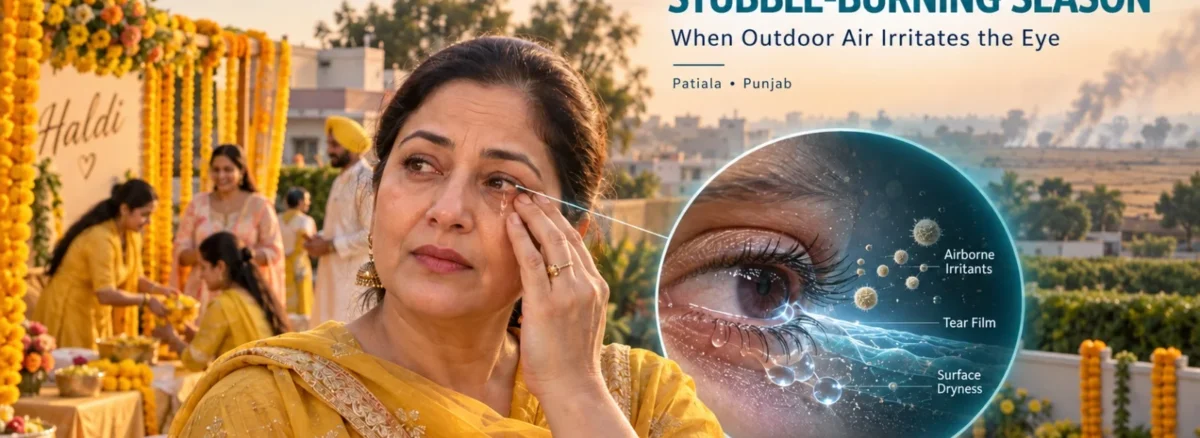
A family in a colony off Rajpura Road has spent weeks planning an outdoor Haldi function for late October — marigold decor, an open lawn, photographs booked for golden hour. Three days before the event, the bride’s mother notices her own eyes watering through the evening, gritty by the time the lights come on. She puts it down to stress and late nights. It isn’t stress. It’s the same thing that happens to half the city every year around this time, and most people never connect the two.
This isn’t unusual or alarming on its own — it’s a measurable, physical irritant load settling on the eye’s surface, tied directly to Punjab’s stubble-burning season, which reliably runs mid-September through November. Knowing that changes what actually helps, especially with an outdoor event on the calendar.
What's Actually Happening to Your Eyes
A thin tear film normally keeps the eye’s surface smooth and protected without you noticing it. During stubble-burning season, fine particulate matter from crop-residue smoke lands directly on that film, breaking its evenness and speeding up tear evaporation — which is why eyes feel gritty, water excessively, and burn worse by evening.

Dry Eye, Allergy, or Infection?
All three flare up in the same season and share overlapping symptoms but need different responses.

| Irritant / Dry Eye | Allergic | Infective | |
|---|---|---|---|
| Feeling | Gritty, burning | Itching | Discomfort, discharge |
| Discharge | Watery | Stringy, clear | Thick, coloured |
| Pattern | Both eyes, gradual | Both eyes, comes and goes | Often one eye first |
Who's Most at Risk of Dry Eye in Patiala's Malwa Belt
This is predictable and recurring, not a one-off — and some groups feel it more sharply. Families hosting or attending outdoor wedding functions this season sit alongside NIS athletes and coaches training long outdoor hours, agricultural workers across the Malwa belt with the most direct exposure, patients with existing dry eye experiencing their annual flare, and contact lens wearers carrying extra risk on top of whichever group they already belong to.

What Actually Helps This Season
Preservative-free lubricating drops used proactively — not just once irritation sets in — make the biggest practical difference, alongside wraparound eyewear outdoors, avoiding peak exposure at dawn and dusk, resisting the urge to rub (a cool compress works better), basic indoor air steps where feasible, and stricter contact lens hygiene through the season.

When to See a Doctor
Most seasonal irritation settles with simple self-care. Pain rather than irritation, light sensitivity, any vision change, symptoms markedly worse in one eye, symptoms persisting beyond a few days, or thick coloured discharge with crusting all warrant a prompt exam rather than more waiting.

What to Expect at Global Eye Hospital
Global Eye Hospital, Patiala is an NABH-accredited super-specialty eye hospital under the clinical leadership of Dr Manpreet Singh, Chief Eye Surgeon. A visit for seasonal irritation typically involves a brief history, a straightforward exam to distinguish irritant, allergic, and infective causes, and a clear next step. Patients from across the Malwa belt — Rajpura, Nabha, Samana, Sirhind, Fatehgarh Sahib, Sangrur and Patran — face the same seasonal pattern described here.
Most seasonal eye irritation responds well to simple protective habits — but persistent or worsening symptoms deserve an actual look, not a guess.
Dry Eye vs. Allergic vs. Infective — Reference Table
| Irritant / Dry Eye | Allergic | Infective | |
|---|---|---|---|
| Feeling | Gritty, burning | Itching | Discomfort, discharge |
| Discharge | Watery | Stringy, clear | Thick, coloured |
| Pattern | Both eyes, gradual | Both eyes, comes and goes | Often one eye first |
Frequently Asked Questions
Not fundamentally — the season aggravates the same tear-film mechanisms as everyday dry eye, but the particulate load makes it more acute for a defined period each year.
They can meaningfully reduce indoor particulate exposure during peak hours, though they don’t eliminate exposure from time spent outdoors.
With extra care — shorter wear times, daily disposables where possible, and stricter hygiene reduce the added risk.
It generally tracks the burning season — building from mid-September, peaking through October into November.
No. Redness appears in irritant and allergic reactions too. Discharge type and whether one or both eyes are affected help distinguish the cause.
They may be appropriate for certain presentations but require a proper diagnosis and prescription — not a self-care option.
Yes — proactive lubricating drops and protective eyewear in the days before an outdoor function help most people manage comfortably.
Reinforcing usual drop use proactively, rather than waiting for a flare, generally helps get through this season more comfortably.
Medical Disclaimer
This article is intended for general information and does not replace individual medical advice. Eye irritation can have several different causes requiring different treatment. If you experience pain, vision changes, or symptoms that do not improve, consult an eye care professional promptly.