

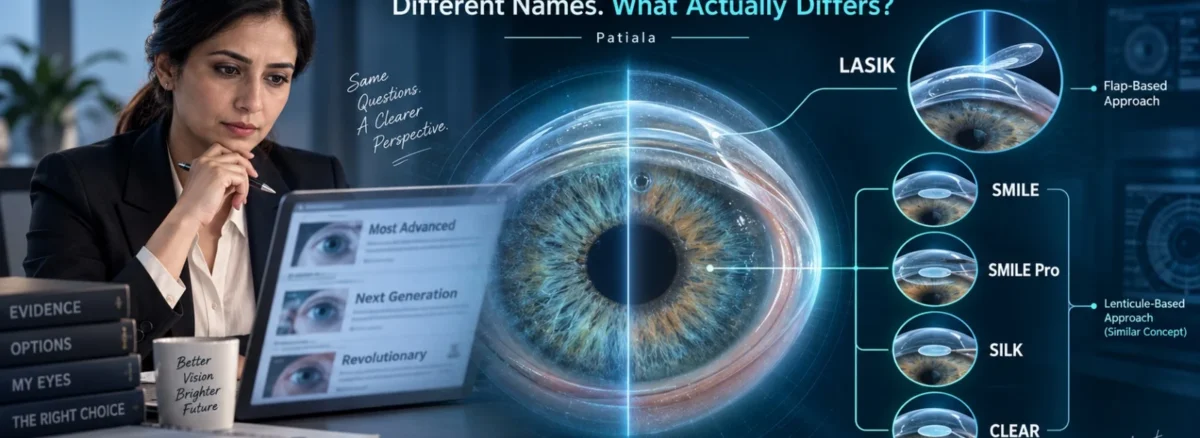
Advocate Ramanpreet Kaur has spent eleven years at the Patiala district courts, and her instinct for a claim that doesn’t quite hold up is close to automatic by now. So when she started researching laser eye surgery earlier this year, she did what she does with any brief: she pulled every source she could find, laid them side by side, and started looking for where they actually agreed.
They didn’t, not obviously. One clinic’s website called SMILE “the most advanced technology available.” Another called CLEAR “the next generation beyond SMILE.” A third pushed SILK as “revolutionary.” Four names, three separate claims to being the best, and not one of them explaining how the others fit into the picture.
A closer reading shows something different: SMILE, SMILE Pro, SILK, and CLEAR are not four competing break throughs. They are variations on two or three genuine surgical approaches, each carrying its own brand name because each manufacturer needs its version to sound distinct in a crowded market.
That commercial pressure is ordinary business behaviour — not a conspiracy, not a deception. But it is genuinely irrelevant to which approach is right for a given pair of eyes, and untangling that is the entire purpose of this article.
Three Technologies, Not Four Brands!
Nearly every laser vision correction procedure offered in Patiala and across Punjab today belongs to one of three underlying surgical concepts. Everything else — every brand name — is a manufacturer’s label sitting on top of one of these three.

Read the chart top-down, not left to right. The technology decides what actually happens to the cornea. The brand name underneath it simply identifies which manufacturer’s version of that technology a given hospital has chosen to install.
Surface Ablation: PRK and TransPRK
The original modern approach to laser correction, and still a genuinely relevant one. The excimer laser reshapes the cornea’s outer surface directly — no flap, no lenticule. Because the surface layer needs several days to regenerate, recovery is more gradual than with flap-based or lenticule-based methods. It remains a real, carefully considered option for certain corneas, particularly thinner ones, rather than a fallback reserved for when nothing else works.
Flap-Based Correction: LASIK, Femto-LASIK, Contoura Vision, Wavefront LASIK

Conventional LASIK and Femto-LASIK both lift a thin, hinged corneal flap before the excimer laser reshapes the tissue beneath it; the flap is then repositioned without stitches. Femto-LASIK uses a femtosecond laser rather than a mechanical blade to create that flap — which is why it’s described as bladeless specifically at the flap-creation step, not across the whole procedure.
Contoura Vision and Wavefront LASIK are not separate procedures. They are customisation layers applied within flap-based LASIK — topography-guided and wavefront-guided treatment planning, respectively — that tailor the laser correction to an individual eye’s own surface irregularities rather than a generic, one-size prescription. Presenting either as if it competes with SMILE or CLEAR is a category error worth correcting directly: they sit inside the flap-based branch, not beside it.
Lenticule-Based Correction: SMILE, SMILE Pro, SILK, CLEAR — One Concept, Four Names
This is where nearly all the brand confusion actually lives — and where Ramanpreet’s five browser tabs kept contradicting each other. SMILE, SMILE Pro, SILK, and CLEAR all share the same underlying concept: a femtosecond laser shapes a small lenticule of tissue within the intact cornea, and that lenticule is removed through a keyhole incision only a few millimetres wide. No flap is created at any point in any of the four.

Platform-specific characteristics — laser speed, spot pattern, incision size — describe how a machine is engineered to behave. They are not, on their own, guarantees of a better outcome for your particular eyes. That still depends on your cornea, evaluated individually.
Why the confusion exists, and why it isn't yours to untangle alone?
Every laser platform manufacturer needs its version of lenticule extraction to sound different from its competitors’. That’s a straightforward commercial reality, not a conspiracy — SMILE, SILK, and CLEAR come from different companies, and each company’s marketing has an obvious incentive to make its own platform sound like a category unto itself.
The result is that a patient comparing “SMILE vs. CLEAR” is often, without realising it, comparing two hospitals’ equipment choices rather than two genuinely different medical strategies. That isn’t a failure of research on the patient’s part. It’s what happens whenever marketing language and clinical language are allowed to blur together — and it’s exactly the kind of blurring a trained eye, courtroom or otherwise, learns to separate out.
What actually decides your technology category?
Not the newest brand name. Not which platform a particular hospital happens to have invested in. A structured diagnostic sequence decides the technology category — surface, flap-based, or lenticule-based: refraction and its stability over time, corneal topography and tomography, corneal thickness (pachymetry), and ocular surface and tear-film health.

That sequence decides the category first. The specific brand or platform within it is a second, later question — and usually a smaller one than the marketing around it suggests.
Which brand names are available, and why that's the second question?
Once a technology category is confirmed as suitable, the specific brand or platform genuinely matters — but it’s a conversation about equipment and clinical experience with that equipment, not a search for the single “best” name on the market. This quick reference decodes the six names patients across Patiala ask about most.

Global Eye Hospital, Patiala — an NABH-accredited super-specialty eye hospital — offers technologies spanning multiple categories, under the clinical leadership of Dr Manpreet Singh, a Singapore National Eye Centre (SNEC)-trained refractive surgeon. That breadth exists for a specific reason: so the technology conversation can begin with your cornea, not with whichever single platform a narrower clinic happens to own
For Patients Across Patiala and the Malwa Belt

Whether the eyes in question belong to a Patiala advocate cross-referencing brochures the way she’d cross-reference testimony, or a patient travelling in from Rajpura, Nabha, Samana, Sirhind, Fatehgarh Sahib, Sangrur, or Patran, the sequence doesn’t change: diagnostic findings first, technology category second, specific brand name last. The distance to Patiala changes how the appointment gets scheduled. It doesn’t change how the decision gets made.
The first question worth asking isn’t which brand name to choose. It’s which technology category your own eyes actually belong to — and that’s a finding, not a preference.
Technology vs. Brand — Reference Table

Frequently Asked Questions
Neither is universally better. Both are lenticule-based, flapless procedures built on different laser platforms. Which fits a given eye depends on that eye’s own corneal findings, not on which brand name is being compared.
Because each hospital has chosen a specific laser platform to invest in, and each platform manufacturer markets its version of lenticule extraction under its own brand name. The underlying surgical concept, for SMILE, SILK, and CLEAR, is shared.
No. Contoura Vision is a topography-guided customisation applied within flap-based LASIK, not a standalone category. The same is true of Wavefront LASIK.
It means no corneal flap is created. Instead, a small lenticule of tissue is shaped inside the intact cornea and removed through a keyhole incision a few millimetres wide — the approach shared by SMILE, SMILE Pro, SILK, and CLEAR.
They belong to the same lenticule-based category and share the same fundamental surgical concept. SMILE Pro and SILK run on different laser platforms, with real but secondary technical differences — not identical, but not different categories either.
Not automatically. A newer platform may offer genuine technical refinements — speed, incision size — but the outcome for any individual eye still depends on corneal thickness, shape, and overall suitability, confirmed through a diagnostic work-up.
Through refraction, corneal topography and tomography, corneal thickness measurement, and an ocular surface assessment — which together determine whether surface ablation, flap-based, or lenticule-based correction fits your eyes, before any specific brand is discussed.
Yes. Two people can share an identical prescription and have meaningfully different corneas — different thickness, different surface shape — which is why the same prescription can lead to two different procedure recommendations after a proper work-up.
No. PRK and TransPRK remain genuinely appropriate for selected patients, particularly those with thinner corneas, and are not simply an older fallback option.
What should I actually ask my surgeon, instead of asking which brand is best?
Medical Disclaimer
Laser vision correction is elective surgery. Suitability varies between individuals and can only be determined after a comprehensive ophthalmic examination. The final choice of technology and platform should be made after discussing corneal measurements, refractive status, expectations, risks and alternatives with a qualified refractive surgeon.