

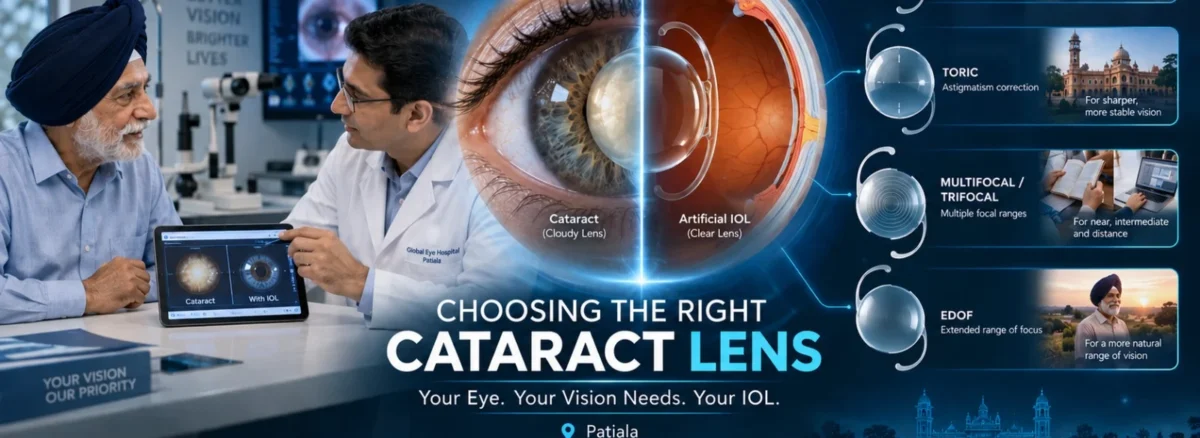
Some where in your fifties or sixties, the newspaper starts asking for better light than it used to. Colours look a shade duller than you remember. Headlights on the highway seem to scatter more than they should at night. For most people, this turns out to be cataract — Safed Motia, as it is known across Punjab — and it is one of the most treatable causes of vision loss.
The diagnosis itself rarely worries people once they understand it. What tends to need real thought is the lens that replaces your eye’s own, because that one decision shapes how you see for years afterward, not just how the surgery goes. This guide walks through what that choice actually involves, and what it tends to mean for patients weighing their options in Patiala and the surrounding towns.
What Cataract Surgery Actually Replaces
Your eye focuses light the way a camera lens does, using a small, transparent structure sitting just behind the iris. Over time — usually from age, sometimes earlier from diabetes, injury, or long-term steroid use — this natural lens turns cloudy. Vision blurs, colours fade, and glare becomes harder to deal with at night. That clouding is the cataract.
Surgery removes the clouded lens and puts an artificial one in its place: an intraocular lens, or IOL. It stays in the eye permanently and does the same optical job the natural lens used to do. There is no scraping it off or wearing it out — once placed correctly, it works for the rest of a patient’s life in the overwhelming majority of cases.
Why the Lens You Choose Matters More Than the Surgery Itself

Cataract surgery today is a short, well-established procedure. What varies far more from patient to patient is the outcome afterward — how often you still reach for glasses, how comfortable night driving feels, whether reading fine print takes effort. That variation comes almost entirely from which IOL was chosen and how well it matches your eyes and habits, not from the surgery itself.
At Global Eye Hospital, the sequence is deliberately unhurried: an eye examination, detailed measurements of the eye, a conversation about what matters to you day to day, and only then a recommendation. Here is roughly how that plays out.
The Lens Options, One at a Time
Monofocal IOL
The lens used in the vast majority of cataract surgeries worldwide, and for good reason — it is well-tested, predictable, and focuses sharply at one distance, almost always set for far vision. Reading and close work will typically still need glasses afterward. For patients who are comfortable with that trade-off, or who have astigmatism-free eyes and a straightforward budget preference, this remains a sound, unglamorous choice.
Toric Monofocal IOL
Built for eyes with meaningful astigmatism, where an irregularly curved cornea blurs vision at every distance rather than just up close or far away. A standard monofocal lens cannot correct that curvature; a toric one is shaped specifically to counter it. Whether you need this version depends entirely on your corneal measurements, taken during the pre-surgery workup.
Multifocal IOL
Designed with more than one focusing zone, so the eye can shift between near and far without swapping glasses for every task. Many patients find this genuinely frees them from constant glasses use. It is not without trade-offs — some people notice glare or halos around lights at night, particularly in the first few months. Clinical comparisons have generally found that once patients adjust, satisfaction with multifocal and monofocal lenses ends up closer than the marketing around either would suggest, which is exactly why this decision belongs in a conversation with your surgeon rather than a shopping comparison.
Trifocal IOL
A step further than multifocal, adding a third focusing zone for intermediate distance — arm’s length, roughly where a laptop or a car dashboard sits. For patients who spend real time on screens or driving, this middle zone tends to matter more than it sounds like it would on paper. The same glare and halo considerations that apply to multifocal lenses apply here too, and vary from person to person.
EDOF IOL (Extended Depth of Focus)
A newer approach that creates one smooth, stretched-out zone of focus instead of distinct near-intermediate-far steps. The idea is to soften the sharp transitions some patients notice with multifocal or trifocal designs, and in practice this often does mean fewer night-time glare complaints. The trade-off is that very close-up vision — small print, fine embroidery work — can be less sharp than with a trifocal lens. Your surgeon can talk you through whether that balance suits your eyes.
How These Lenses Compare on Vision Coverage
Put side by side, the practical difference between these lens families comes down to how much of your visual range each one covers without help from glasses.
What Drives the Cost Difference
Lens pricing depends on the technology inside it, the brand, whether astigmatism correction is built in, and the surgical approach used alongside it — standard phacoemulsification versus laser-assisted or robotic-assisted techniques. Rather than publish fixed figures that go stale within months and vary by exact lens model anyway, our team prefers to walk you through a written, itemised estimate once your evaluation is complete. As a rough sense of how the categories sit relative to each other:
One distinction worth understanding before any quote is discussed: whether a figure covers the lens alone, or the complete surgery — surgeon’s fee, operation theatre charges, pre-operative testing, anaesthesia, and follow-up visits included. Two patients choosing what sounds like the same lens can end up comparing very different totals simply because one number was lens-only and the other wasn’t. Always ask which one you’re looking at.
Premium Lenses: Worth It, or Not?

“Premium” generally refers to anything beyond a standard monofocal — multifocal, trifocal, EDOF, and their toric variants. The appeal is obvious: less time spent hunting for glasses. The honest answer is that a premium lens is worth it for the right eyes and the right expectations, and not automatically worth it otherwise. Reported outcomes between premium and standard IOLs, in patients who were properly matched to their lens in the first place, tend to be closer than the price gap between them implies. The lens that suits you is the one chosen after an examination, not the most expensive option on a brochure.
Matching a Lens to Your Everyday Life
A useful way to think about this is less “which lens is best” and more “what does my day actually demand of my eyes.” A few examples that come up often in consultations:
- Long drives on the highway, especially after dark: night glare tolerance matters more than usual, and this is worth flagging early.
- Farm work, gardening, or anything outdoors most of the day: consistent distance vision without constantly reaching for glasses often ranks high.
- Fine handwork — tailoring, embroidery, jewellery, detailed paperwork: sharp near vision deserves particular attention when comparing lenses.
- Teaching, presenting, or a desk job built around screens: the intermediate zone that trifocal and EDOF lenses cover can be more useful than it first appears.
- A simple preference to keep things straightforward and cost-conscious: a monofocal lens, paired with reading glasses, remains a perfectly reasonable choice.
None of this replaces an actual eye examination — it just gives you a better starting point for that conversation.
Five Questions Worth Asking Before You Decide

Cataract Care Close to Home: Global Eye Hospital, Patiala
Global Eye Hospital has been treating patients from Patiala and the wider region since 2012, and holds NABH accreditation as a super-specialty eye care centre. Patients travel in regularly from Rajpura, Nabha, Samana, Sirhind, Fatehgarh Sahib, and Sangrur for cataract evaluations, which says less about distance and more about not wanting to compromise on who handles their eyes.
What an Evaluation at Global Eye Hospital Involves
A full eye examination, biometric measurement of your eyes to calculate the correct lens power, a review of any other eye conditions that might influence the decision, and a straightforward conversation about your daily routine and visual priorities. Only then do we make a specific lens recommendation — and you leave with a written estimate, not a verbal guess.
About Dr. Manpreet Singh
Dr. Manpreet Singh is the Chief Cataract Surgeon and founder of Global Eye Hospital, Patiala, where he has led the cataract and IOL programme since the hospital’s founding in 2012. His practice covers the full range of cataract lens options discussed in this guide, from standard monofocal implants to premium multifocal, trifocal, and EDOF lenses, matched individually to each patient’s eyes and lifestyle rather than offered as a one-size recommendation.
Frequently Asked Questions
Safed Motia — also called Motiyabind — is the common Punjabi and Hindi term for cataract, the clouding of the eye’s natural lens. It is the same condition this entire guide is about, and it is treated through cataract surgery with IOL implantation.
Through an eye examination and biometry, not guesswork. Your surgeon will look at your corneal shape, retinal health, and lifestyle before recommending anything specific.
No lens can promise that for every patient. Most people notice a significant reduction in how often they reach for glasses, but individual results vary, and your surgeon can give you a realistic sense of what to expect based on your eyes specifically.
That depends entirely on how the quote was prepared, which is exactly why we recommend asking for a written, itemised estimate rather than relying on a single figure. Our team is happy to walk you through this once your evaluation is complete.
In the vast majority of cases, for life. IOLs are not designed to be replaced or serviced the way glasses or contact lenses are.
Age alone rarely rules a patient out. What matters more is overall eye health and any other medical conditions, which your surgeon will review as part of your evaluation.
Book Your Consultation
If cataract or lens questions have brought you here, the most useful next step is an eye examination — not a decision made in advance of one. Dr. Manpreet Singh and the team at Global Eye Hospital can walk you through your specific options, in plain language, with a written estimate once your evaluation is complete.
Call for an appointment: +91 9988661075 | 9115100501
Global Eye Hospital, S.S.T Nagar, Rajpura Road, Patiala, Punjab
Medical Review
This article is medically reviewed by Dr. Manpreet Singh — Chief Cataract Surgeon, Global Eye Hospital, Patiala.